Borusan Contemporary,
is a contemporary art, collection and education initiative of the Borusan Kocabıyık Foundation.
Personal Data Protection
Cookie Policy
© Borusan Contemporary, 2026.
Current Exhibitions
Time Space Geometry
19 September 2026 - 15 August 2027
TEMPORARY EXHIBITION
CURATOR: FIRAT ARAPOĞLU
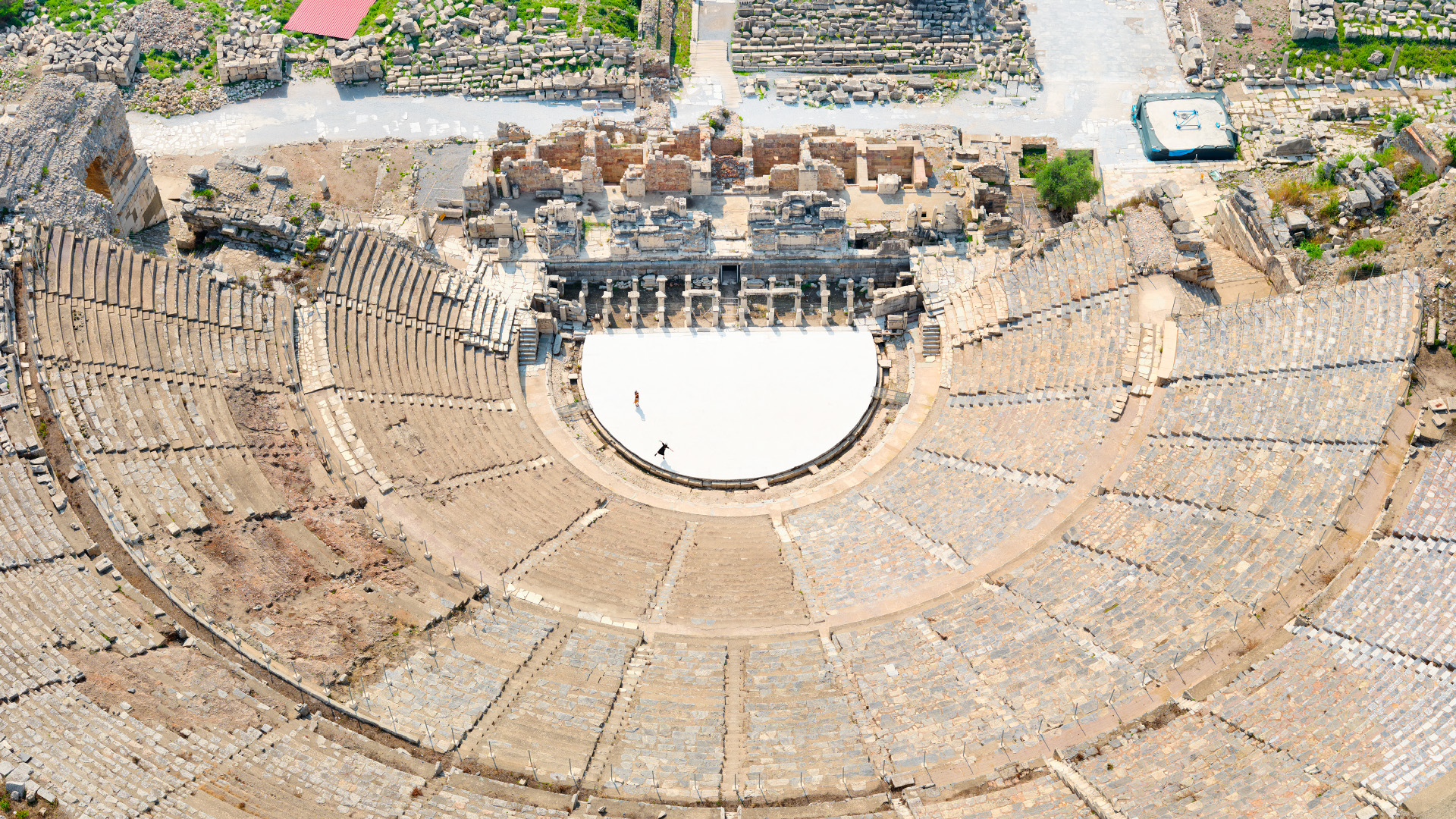
Olivo Barbieri, Efes Türkiye , 2023
Borusan Çağdaş Sanat Koleksiyonu
Olivo Barbieri’s photographic practice should be viewed as a radical aesthetic proposal that invites us to rethink the act of looking at a landscape. His works pose questions not only about what is visible but also about how objects are perceived. Through his practice spanning nearly four decades—and particularly through the optical intervention techniques he developed beginning in the 2000s—he has imparted a unique visual perspective to architectural structures, natural formations, and urban landscapes. Barbieri’s frames, so to speak, disrupt and reconfigure the experience of seeing, stripping scale, perspective, and space of their familiarity and transforming them into the very act of representation itself.
The exhibition brings together the artist’s five main series, presenting a comprehensive map of Barbieri’s relationship with landscape, time, space, and memory. Time Space Geometry (2023), site specific_ (1999–2013), The Waterfall Project (2006–2007), Alps - Geographies and People (2012), and Capri (2013) form a thematic continuum that spans archaeological sites to global metropolises, from the relationship between nature’s grandeur and human fragility to the image-laden shores of the Mediterranean.
The exhibition begins with Ancient Anatolian Archaeological Sites, re-examining archaeological cities stretching from Ephesus to Aphrodisias, and from Hierapolis to Laodikeia, through aerial views. Barbieri reimagines ancient theaters and architectural ruins as visual representations of perception as it transforms and evolves through the prism of memory. In these photographs, temporal layers intertwine, and the stones of the past are reshaped through today’s visual language. While Barbieri may appear to be an archaeologist here, he is, in fact, a cartographer, a historian, and, at his core, a set designer. In these images, each city transforms into a metaphor and an object of memory.
The site specific_ series focuses on cities such as Los Angeles, Istanbul, and London—which, when viewed from above, appear almost like models. This perspective is not just a technical result; it invites its viewers to question the city’s complexity, artificiality, and representation. Here, Walter Benjamin’s flâneur transforms into an aerial observer as architecture, geography, and politics intertwine, positioning cities as both real and fictional, both lived-in and designed spaces.
The Waterfall Project looks at the world’s biggest waterfalls, from Cambodia to Zimbabwe and from Canada to Brazil. In these images, nature changes from a romantic idea of the "sublime" to something staged, shaped by lights, terraces, and tourist buildings. Barbieri presents waterfalls as both natural wonders and symbols of culture and economy, revealing how nature is turned into spectacle.
Continuing this consideration of the concept of perception of nature as a kind of staging, Alps - Geographies and People is a visual reflection on people and nature. The Alps' high peaks, snowy slopes, and climbers on cliffs show ideas of the “sublime.” Like the traveler in Caspar Friedrich’s paintings, these people seem alone and small next to nature. Instead of praising nature, Barbieri uses his lens as a symbol for how we see it. Nature is remembered, imagined, and built, not just seen as it is.
Capri series represents a dreamlike conclusion to a landscape brimming with Mediterranean cultural imagery. Carrying a memory that stretches from Tiberius to Pablo Neruda, the island of Capri breaks away from reality within Barbieri’s frame; through pastel hues, intense filters, and selective focus, it transforms into a dream. As Roland Barthes demonstrates in Mythologies, beauty here appears as a staged spectacle. Capri is no longer merely an island; it is a projection of memory and a site of representation.
Barbieri prompts us to ask: How do we look at a landscape today? Do we witness it or imagine it? Does the act of seeing reconstruct a moment or create a new reality? Where the Perili Köşk’s (Haunted Mansion) history meets its modern use, Barbieri’s art explores past and present, reality and illusion. Barbieri’s work is both a visual and an intellectual journey. Are you ready for it?
Click for the exhibition brochure.
 Baltalimanı Hisar Cad.
Perili Köşk No:5 34470
Rumelihisarı / Sarıyer
İstanbul Türkiye
 0 (212) 393 52 00
  info[at]
borusancontemporary
[dot]com
ADMISSION
Adult: 350 TL
Discounted: 100 TL
Group: 300 TL
VISITING
HOURS
Saturdays and Sundays only
10.00—19.00
Last Entry: 18.00
Borusan Contemporary,
is a contemporary art, collection and education initiative of the Borusan Kocabıyık Foundation.
Personal Data Protection
Cookie Policy
© Borusan Contemporary, 2026.
is a contemporary art, collection and education initiative of the Borusan Kocabıyık Foundation.
Personal Data Protection
Cookie Policy
© Borusan Contemporary, 2026.
FOLLOW






BORUSAN CONTEMPORARY